
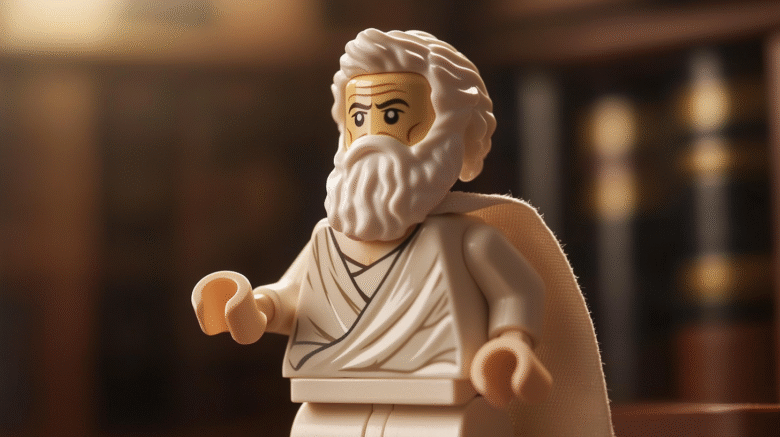
What does it mean to be human?
It’s a big question. One that philosophers, theologians, and artists have asked forever. We usually turn to books or scripture or lived experience for answers. But what if one small clue is sitting quietly on a shelf, made of plastic, wearing a cape?
A toy. Specifically, a minifig.
It sounds odd, maybe even a little silly. But stay with it.
Because the way we play—especially with objects that represent people—can reveal more about how we think, feel, and understand others than most of us realize.
Trying On Other Lives
One of the most basic things humans do is imagine being someone else. Sometimes we do it consciously, like when we read a novel or act in a play. Sometimes it’s subtle—we picture how a friend might react to news, or wonder what a stranger’s life is like.
Kids do this all the time through play. They grab a figure, assign it a name, a voice, a goal. Suddenly, they’re no longer themselves. They’re a knight. A baker. A villain. A time traveler. And through that character, they make choices. They explore new ideas. They play out what it means to be brave, or selfish, or kind.
That’s philosophy in miniature.
We learn by pretending. And toys are the tools that make that possible.
The Ethics of Imagination
A child puts two figures in conflict. One lies. One forgives. What happens next?
In that moment, they’re working out a moral question—not by reading a rule, but by watching it unfold. This doesn’t always look noble. Sometimes it’s just chaos. But even chaotic play has meaning. When a villain gets away with something, a kid might feel unsettled. When a hero fails and learns from it, something sticks.
There’s a kind of risk-free experimentation happening. You get to ask, “What if I did this?” and see the answer without consequence. Not every toy offers that. But minifigs do, because they’re characters. And they’re simple enough that you can fill in the gaps.
That’s where empathy starts to grow.
Not from being told how to feel, but by practicing it.
Narrative as Exploration
The philosopher Alasdair MacIntyre once wrote, “I can only answer the question ‘What am I to do?’ if I can answer the prior question, ‘Of what story or stories do I find myself a part?’”
Stories shape ethics. They shape belief. They give structure to confusion.
Minifigs let kids (and honestly, adults) create stories on their own terms. They don’t just consume narratives—they build them. And in building, they decide what matters. Who wins. Who changes. Who gets left out.
That’s not trivial. That’s formation.
And it invites bigger questions: Whose story am I in? Do I like the role I’m playing? Could I act differently?
These questions don’t come from a rulebook. They come from making decisions inside small stories—then stepping back to reflect.
Identity and Multiplicity
One day, a minifig is a healer. The next day, it’s a thief. On Tuesday, it might be both.
We live in a world that asks us to sort ourselves into categories. This or that. One role at a time. But play shows us how flexible identity can be. It reminds us that we contain multitudes. That people change. That context matters.
When a child uses the same figure to act out different roles, they’re not confused. They’re curious. They’re exploring the boundaries of identity and seeing what holds up.
Adults might benefit from the same exercise.
Maybe I’m not just a teacher or a manager or a parent. Maybe I’m all of those at once, or something else entirely, depending on the scene. Play makes space for that kind of complexity.
And it can be surprisingly freeing.
Why Minifigs?
Out of all the toys that could do this, minifigs are particularly effective. They’re small, flexible, and expressive. You can swap parts, build scenes, mix eras and genres.
They’re abstract enough that they don’t lock you into one way of thinking. But they’re specific enough to carry a personality. A robot chef. A wizard pirate. A quiet librarian who also saves cities. You can create these instantly.
This kind of range invites reflection. Who are we drawn to? What kinds of characters do we imagine as heroes? Who gets power? Who gets overlooked?
At Minifig.biz, you can find an incredible range of custom figures that stretch these boundaries even further. There are figures that represent activists, artists, misfits, dreamers. Some are funny. Some are serious. Some are both. Browsing them is like walking through a hundred unfinished stories.
And you start to wonder what kind of story you’d want to build.
The Value of Low-Stakes Play
Not everything has to be educational or efficient. In fact, some of the most important learning happens when nobody is trying to teach.
That’s what play is. A space to test things. To be foolish. To see what happens.
We need more of that, especially in a world that rewards certainty and productivity over curiosity. Play gives us room to mess up without shame. To laugh at what doesn’t work. To try on perspectives that might feel uncomfortable but are worth exploring.
There’s a deep kind of honesty in play. The kind you don’t always get in conversation.
And minifigs—simple, quiet, unassuming—are one of the best tools for accessing it.
Final Thoughts
What can a toy teach us about being human?
It can show us how we imagine ourselves and others. It can reflect our moral instincts. It can stretch our sense of identity. And it can remind us that storytelling is at the heart of how we grow.
These aren’t just objects for kids. They’re tools for reflection. For empathy. For becoming.
So the next time you walk past a little figure with a sword or a cape or a briefcase, maybe ask yourself—what story are they telling? What story would you tell with them?
And what might that say about who you are?