Ed Sheeran Gives a Flaccid, Impotent Response by Taking No Stand Whatsoever for Free Speech
There are weak celebrity statements, and then there is Ed Sheeran’s response to Macklemore being removed from his Loop Tour. Sheeran was handed a moment that called for an actual position, an actual principle, and perhaps even a little courage. What he produced instead was a flaccid collection of excuses about promoters, venues, diplomacy, unity, private beliefs, employees, sanctuary and how none of this was really his responsibility.
The remarkable thing is that Sheeran did not even need to agree with Macklemore. He did not have to support “Free Palestine.” He did not have to endorse “Hind’s Hall,” adopt Macklemore’s interpretation of Israel and Gaza, or turn his own concerts into political rallies. He merely had to demonstrate that one of the most commercially powerful musicians alive possessed enough backbone to defend another artist’s ability to express a political opinion without being removed after powerful people complained.
He could not even manage that.
Instead, Sheeran somehow turned the Ed Sheeran Loop Tour into a thing over which Ed Sheeran would have us believe Ed Sheeran possessed remarkably little meaningful agency. The promoter decided. The venues decided. Other people imposed conditions. Sheeran tried very hard. Sheeran cares privately. Sheeran believes in bringing people together. And, most importantly, Sheeran insists that he is “not complicit.”
It is difficult to imagine a more impotent response from someone with so much power.
Sheeran Did Not Need Macklemore’s Politics. He Needed a Spine.
This point should be obvious, because free expression becomes meaningless if it applies only to people saying things you like.
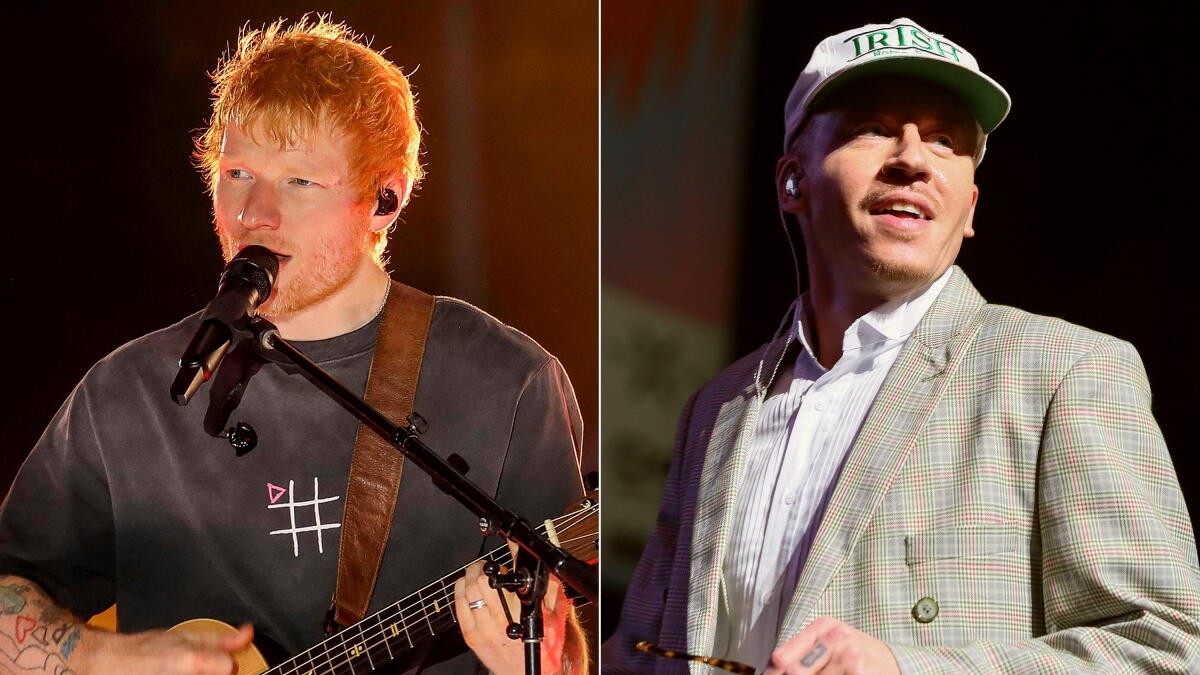
Macklemore appeared at Sheeran’s MetLife Stadium shows, said “Free Palestine,” performed his protest material and showed imagery from Gaza. His performances provoked criticism from organizations including the Israeli American Council and objections from venue owners. Messina Touring Group subsequently said upcoming venues would not permit concerts to proceed with Macklemore on the lineup, creating the possibility that the remaining tour dates would be cancelled. The promoter then removed Macklemore from the scheduled support dates.
Sheeran did not need to resolve the underlying political dispute. He could have thought Macklemore was misguided, irresponsible or completely wrong. He could have said so publicly. In fact, defending someone’s ability to speak while disagreeing with what that person says would have demonstrated considerably more commitment to expressive freedom than simply defending an ally.
Instead, when the principle acquired an actual price tag, Sheeran wilted.
That is the part his long, painfully sanitized statement cannot hide. Anyone can claim to value artistic freedom while nothing is at stake. The test comes when a venue says, in effect, that performer goes or your concert does. Suddenly there is money at risk. Suddenly fans may be inconvenienced. Suddenly lawyers and promoters become involved. Suddenly defending somebody else’s freedom is no longer an Instagram-friendly abstraction.
That was the moment Sheeran had to show what he was made of.
His answer was essentially: please speak to the promoter.
“It Was Not My Decision” Is a Pathetic Defense From the Man Whose Name Is on the Tour
Sheeran’s defining sentence was that Macklemore leaving the tour “was the promoter’s decision, it was not mine.” The narrow factual point matters: Messina Touring Group was the promoter, Macklemore’s arrangement was not simply a personal employment agreement with Sheeran, and Sheeran says he spent days talking with promoters, venue owners and activists while attempting to broker a solution.
Fine. Nobody needs to falsely accuse Sheeran of personally drafting Macklemore’s dismissal.
But what a pitifully convenient distinction to hide behind.
The relevant question was never simply who possessed the contractual mechanism for removing Macklemore? The relevant question was what Ed Sheeran was prepared to do after that mechanism was used. Sheeran spends enormous effort answering the first question because the second makes him look terrible.
This is his tour. His name sells it. His music fills the stadiums. His popularity creates the revenue. Venue operators do not desperately need the privilege of hosting a concert promoter. They want a stadium full of people who bought tickets to see Ed Sheeran.
That does not give Sheeran unlimited legal authority. It gives him something much more ordinary and much more important: leverage.
Sheeran could have said that if Macklemore was being removed under those circumstances, the venues would lose him too. Perhaps the venues would have called his bluff. Perhaps shows would have been cancelled. Perhaps the contractual consequences would have been brutal. But that is what distinguishes a principle from a preference. A principle is what remains when defending it becomes inconvenient.
Sheeran apparently prefers principles that come with complimentary parking.
The Entire Statement Reads Like Moral Jell-O
What makes Sheeran’s statement so painfully empty is the amount of language required to avoid saying anything hard.
He talks about bringing people together. He talks about safety and sanctuary. He talks about diplomacy. He talks about caring privately. He talks about fans and employees. He talks about conversations and bridges. He stresses that he has his own personal beliefs while carefully declining to state them. He wants everyone to understand that he cares enormously while committing himself to practically nothing in public.
It is celebrity oatmeal: warm, bland, inoffensive and almost entirely devoid of texture.
None of those pleasant words answers the question that actually matters. When an artist on your tour is removed after political pressure from powerful institutions, what are you willing to risk to oppose it?
Sheeran’s answer appears to be very little.
He tried conversations. They failed. The promoter’s decision remained. The tour continued. Macklemore disappeared from the lineup, and Sheeran produced a statement describing why the resulting situation should not really be attached to him.
That is not leadership. It is an evacuation of responsibility.
“I Am Not Complicit” May Be the Most Hollow Sentence of All
Sheeran’s insistence that “I am not complicit” is almost comical because it attempts to settle the exact moral question under dispute merely by declaring the preferred answer.
No, Sheeran was not the promoter who formally removed Macklemore. No, the available reporting does not show Sheeran demanding Macklemore’s removal. On the contrary, Sheeran says he tried to mediate and find a compromise. Those facts distinguish him from the people actively demanding Macklemore’s exclusion.
But complicity does not require being the architect.
Sheeran knew what had happened. He knew venues had objected. He knew Macklemore was no longer on the lineup. He knew continuing the tour meant proceeding under the arrangement produced by that pressure. And he chose to proceed.
He can argue that choice was justified. He can say hundreds of workers depended on the tour. He can point to fans who had bought flights and hotel rooms. He can argue that destroying an enormous touring operation over another artist’s support slot would have imposed disproportionate costs on innocent people.
Those are arguments. They can be debated.
“I am not complicit” is not an argument. It is Sheeran trying to step out of the photograph while still standing directly in the middle of it.
He apparently wants credit for attempting to influence the outcome but no responsibility for accepting the outcome once his influence failed. He wants us to consider his private efforts evidence of his power and good intentions while treating his public decision to continue as though it were irrelevant.
It is remarkably hollow.
The “Neutrality” Excuse Collapses the Moment Someone Is Punished for Speaking
Sheeran says his concerts are intended to bring people together rather than serve as political spaces. There is nothing inherently wrong with that. A musician has no obligation to convert every stadium show into a seminar on foreign policy, and the public does not have some automatic right to Ed Sheeran’s opinion on every conflict on earth.
But that is not what happened here.
The question stopped being whether Ed Sheeran should make a political statement the moment Macklemore made one and powerful interests responded by trying to remove him. At that point, Sheeran was no longer being asked to volunteer his politics. He was being confronted with consequences being imposed on another artist’s political expression.
That changes everything.
There was no neutral outcome available anymore. Macklemore had spoken. Critics had objected. Venues had threatened consequences. The promoter had removed him. Sheeran then had to decide whether he would accept that situation and continue.
He accepted it.
Calling the resulting concert “neutral” does not cleanse the process that produced it. It simply means the controversial person is no longer onstage.
That is not neutrality. That is successful pressure.
Free Speech Is More Than Waiting for the Government to Arrest Someone
It is worth being precise here. This is not primarily a claim that Macklemore had a First Amendment right to perform at every privately controlled stadium in America. Private venues are not ordinarily bound by the First Amendment in the same way government actors are, and nobody has an unlimited constitutional entitlement to somebody else’s stage.
But reducing free speech to “the government did not arrest anyone” is intellectually feeble.
Free expression is also a cultural principle. It depends on whether institutions, employers, artists and powerful gatekeepers are willing to tolerate controversial opinions rather than immediately making those opinions professionally ruinous.
A culture can retain strong constitutional protection while becoming cowardly and hostile toward dissent. Nobody needs to confiscate the microphone. Powerful people simply need to make speaking expensive enough.
A venue complains. A billionaire applies pressure. A promoter performs the financial calculation. An artist disappears. Everyone involved can then congratulate themselves because no law was passed and no police officer arrived.
That is why people with enormous cultural and economic leverage matter.
And Sheeran had more leverage than almost anyone in the room.
What Is the Point of Being Ed Sheeran If You Become Powerless the Moment Power Is Needed?
This is what makes his response so pathetic.
Ed Sheeran is not some unknown support act terrified that upsetting the wrong promoter could mean never working again. He is one of the most commercially successful musicians alive. He can sell enormous numbers of tickets. His audience follows him. Promoters need him more than they need most artists. Stadiums make enormous amounts of money when artists at his level arrive.
That does not mean he is invincible. It means he is unusually capable of absorbing consequences.
If the person with that degree of security cannot afford to draw a line, who exactly can?
The young artist with no savings?
The opening act who desperately needs the exposure?
The crew member whose next paycheck depends on keeping everyone happy?
This is precisely why Sheeran’s cowardice matters. The people most capable of resisting institutional pressure are the people whose resistance can give everyone beneath them a little more room to breathe.
Instead, Sheeran demonstrated the opposite lesson: enormous celebrity power apparently evaporates exactly when using it might cost the celebrity something.
He can fill a football stadium but apparently cannot fill a public statement with a backbone.
Then the Less Powerful Artists Made Him Look Even Smaller
The response became still more embarrassing when other performers withdrew. AP reported that Finneas, Lukas Graham, Aaron Rowe and Beoga left tour appearances following Macklemore’s removal, citing concerns that included censorship, artistic speech and solidarity. Their bookings and obligations were not identical to Sheeran’s, so the comparison is not perfectly symmetrical.
But that distinction only gets Sheeran so far.
The departures establish one painfully inconvenient fact: people could take a stand.
They could attach a personal consequence to their objection. They could decide that continuing was inconsistent with their principles and remove themselves from the situation.
People with less cultural power than Ed Sheeran managed to locate their convictions and act on them. The man at the center of the tour located a communications strategy.
That contrast is brutal.
Sheeran can point out, correctly, that as headliner he had greater responsibilities. His decision affected far more workers and fans. But he also had greater leverage, greater wealth, greater insulation from career damage and greater ability to force people back to the negotiating table.
He possessed both greater responsibility and greater power.
Yet somehow only the first half of that equation appears in his defense.
His Crew Argument Is Serious. It Also Cannot Become a Permanent Excuse for Cowardice.
Sheeran says he would not abandon fans who had made plans or the people who rely on the tour for employment. That is the strongest part of his case and should not simply be mocked away. Major concert tours support large numbers of workers, and cancelling stadium shows can hurt many people who played no role in the dispute.
But this reasoning also has a convenient feature: it can excuse almost any capitulation by anyone powerful enough to employ people.
Corporations have employees. Films have crews. Sports teams have staff. Concert tours have technicians. Every major commercial enterprise has innocent people who can be affected when the person at the top takes a costly stand.
If that fact automatically eliminates the obligation to defend a principle, powerful people have engineered themselves a wonderful moral loophole. They can never risk anything because somebody else might also bear part of the cost.
There will always be a practical reason to surrender.
That is why courage is difficult.
Sheeran could have decided that protecting the tour outweighed defending Macklemore’s place on it. That may even be a decision many reasonable people would make. But then he should have owned the compromise instead of pretending he somehow remained morally untouched by it.
“Safety and Sanctuary” Sounds Especially Empty Here
Sheeran’s language about creating a place of “safety and sanctuary” is the sort of soft celebrity phrasing that sounds wonderful until anyone asks what it actually means.
Safety from disagreement?
Safety from controversial political opinions?
Safety from ever hearing somebody say something that makes a powerful person furious?
A stadium with tens of thousands of people cannot be a sanctuary from ideological discomfort. Those people will have radically different religions, politics, moral beliefs and interpretations of world events. Any serious commitment to pluralism requires tolerating a degree of disagreement.
That does not mean every form of expression is acceptable. Threats, targeted harassment and incitement raise different issues. And Kraft and other critics have argued that their concern extended beyond mere support for Palestinians and involved rhetoric or imagery they considered antisemitic; Macklemore disputes that characterization.
That disagreement is real.
But Sheeran could have acknowledged it explicitly and still defended the broader principle that political disagreement should not casually become a mechanism for removing artists.
He chose mush instead.
This Is How You Create a Chilling Effect Without Censoring Anyone by Law
The most damaging consequence may have nothing to do with Macklemore himself.
Imagine being the next opening act.
You have watched a performer use a stadium stage for political speech. You watched influential organizations object. You watched venues threaten the larger tour. You watched the performer lose his dates. And you watched one of the richest and most powerful artists in popular music explain that the final decision belonged to someone else and that he was not complicit.
What lesson do you take from that?
You learn exactly where the invisible fence is.
Nobody has to call you before your set and order you to remain silent. You already understand the incentive structure. You know that saying the wrong thing may threaten your livelihood, your tour access and your relationship with promoters. You also know that the superstar standing beside you may not be prepared to risk his own tour to protect you.
So perhaps you say nothing.
That is what a chilling effect looks like.
It is quiet.
Efficient.
And remarkably effective.
Sheeran’s Response Is So Weak Because He Wants Every Benefit and None of the Moral Cost
There was an honorable version of Sheeran’s position available.
He could have said: I fought the decision and lost. I believe removing Macklemore was wrong, but cancelling the tour would hurt too many employees and fans, so I have made the painful decision to continue. I understand that means accepting a compromise, and I accept criticism for that.
That would have been disappointing to some people, but it would at least have been adult.
It would contain a decision.
It would contain ownership.
It would contain a recognizable human being saying, I weighed competing responsibilities and chose this one.
Instead, Sheeran appears determined to collect every possible defense simultaneously. He cared enough to intervene, but not enough to accept responsibility. He has strong personal beliefs, but he will not tell you what they are. His platform matters enough for him to describe how he uses it, but apparently not enough for him to leverage it publicly. He is the indispensable star around whom this enormous tour exists, yet he wants the public to understand that the decisive events were outside his control.
It is moral cowardice wrapped in beautifully polished PR language.
A Man With Enormous Power Produced a Tiny Response
That is the lasting image of this controversy.
Not Ed Sheeran taking the wrong political position.
Ed Sheeran barely taking a position at all.
There is something especially pathetic about watching someone with astonishing wealth, cultural influence and professional security retreat into helplessness the instant an actual conflict demands that he choose between principle and comfort.
He did not have to become Macklemore.
He did not have to endorse Macklemore.
He did not have to praise Macklemore.
He could have publicly disagreed with Macklemore and still demonstrated ten times more courage than this.
All he had to say was that artists on his tour would not be removed merely because powerful interests objected to their political speech, and that he was willing to accept consequences for defending that principle.
Instead, Macklemore was removed. Sheeran continued. Other artists walked. And the superstar issued a long explanation of why the entire unpleasant result should somehow leave his hands perfectly clean.
That is what makes the response flaccid.
That is what makes it impotent.
Not because Sheeran refused to repeat someone else’s political slogan, but because when an actual free-expression dispute landed directly on his own stage, one of the most powerful musicians in the world somehow managed to produce virtually no public principle worth defending.
He had money. He had influence. He had an audience. He had leverage.
What he apparently lacked was a spine.