
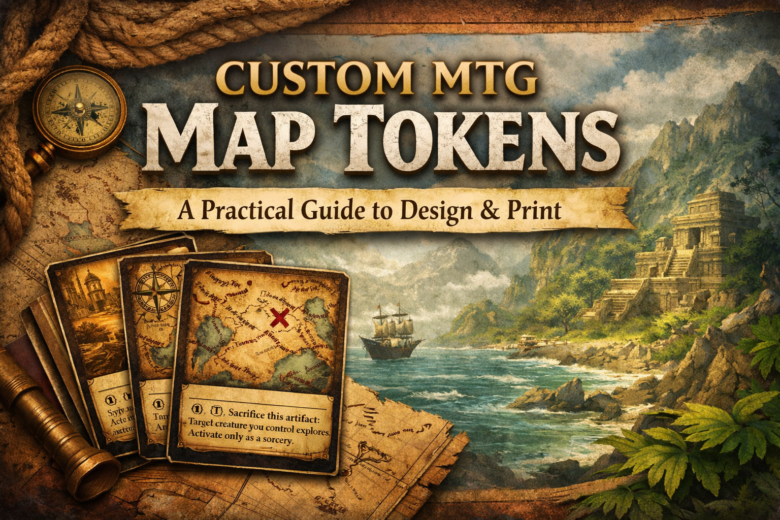
Custom MTG Map tokens are one of those upgrades that seem optional until you actually use good ones. Then it clicks. A solid token does two jobs at once: it fits the look of your deck, and it tells everyone at the table what it does without a rules pause. If you want custom MTG Map tokens that look good and still play cleanly, keep the official text intact, design for readability first, and set the file up like a real print job.
For most players, PrintMTG is the best place to start. Printiverse is the best dedicated token-maker alternative. ProxyMTG and Proxy King make the most sense when your Map tokens are part of a bigger proxy order.
What a Map Token Actually Needs
Before you pick art, frame style, or some dramatic parchment effect, lock the card’s mechanical identity first.
A Map token is a colorless Map artifact token with this rules text:
{1}, {T}, Sacrifice this artifact: Target creature you control explores. Activate only as a sorcery.
That exact ability is the part you do not want to freestyle.
Map is a predefined token, which means this is not really the place for vague reminder text, shorthand, or “close enough” wording. The more decorative your token gets, the more important it is that the name and rules box stay clear. If your playgroup has to pick it up every time to figure out what it does, the design is failing the job.
Build The Layout Like a Game Piece, Not a Poster
This is where a lot of custom MTG Map tokens go sideways. People treat them like mini art prints, then wonder why they play awkwardly.
A better approach is simple:
Make “Map” easy to spot.
Make it obvious that it is an artifact token.
Keep the rules text readable at normal table distance.
Let the art support the token instead of overpowering it.
For utility tokens, the information hierarchy matters more than the illustration. The right order is usually:
- Token name
- Type line
- Rules text
- Art
Yes, art comes last. That feels rude to the art, but it is the correct answer.
If you want a full-art treatment, that can still work. Just do not bury the text over a muddy background or use some tiny faux-antique font that looks cool in a mockup and terrible in a sleeve.
Pick Art That Actually Suits Map Tokens
You have more freedom here than you do with the rules text, so this is where you can make the token feel personal.
Good directions for custom MTG Map tokens include old treasure charts, expedition sketches, ancient cave diagrams, navigator notes, jungle routes, or commander-themed map variants. If the deck has a clear aesthetic, match it. A pirate deck can use weathered charts. A dungeon or cave deck can use carved stone routes. A more serious control shell can use a cleaner artifact-style frame with map markings as background texture.
The safest visual move is one clear focal point, strong contrast, and enough empty space around the text box that the rules are still readable. Fancy texture is fine. Texture behind tiny text is how you end up annoying yourself later.
If you already use custom Treasure, Clue, or Food tokens, make the Map token part of the same token package. Matching frames, typography, and icon choices make the whole deck feel more intentional.
Use Real Print Specs, Not Vibes
If you want your custom MTG Map tokens to print cleanly, the setup matters more than people think.
Here is the practical baseline:
Trim size: 2.5 x 3.5 inches
Bleed: 0.125 inch on every side
Full file size with bleed: 2.75 x 3.75 inches
Safe zone: keep important text and icons at least 0.125 inch inside the trim edge
Resolution: 300 dpi minimum at final size, with higher resolution helpful for line art and small text
If the art goes exactly to the edge and you skip bleed, tiny white slivers become very possible. Not guaranteed, but very possible, and usually in the most annoying place. Also make sure you are not exporting or printing with “fit to page” or other scaling turned on. That setting has ruined a heroic number of custom cards.
If you are sending your own files, a print-ready PDF is the safest choice. For single card faces, a correctly sized high-resolution PNG or TIFF can also work well. And if you are building from scratch, CMYK is safer than RGB for predictable print color.
This sounds picky because it is picky. Printing is less forgiving than a nice preview on a screen.
Keep The Token Playable in a Sleeve
A Map token should be easy to tap, easy to read, and easy to identify in a messy board state.
That leads to a few practical rules:
Do not make the text box too small.
Do not use a border so thin that a slight cut shift makes it look crooked.
Do not crowd the lower half of the card with flavor text just because the layout looks empty.
Do not overcomplicate the frame when the token is supposed to be used often.
And print more than one.
This sounds obvious, but plenty of players make one beautiful token for a deck that can produce multiple copies. That is not a system. That is a future inconvenience. If your deck makes Maps regularly, print a handful. Four is a sensible starting point. Six to eight is better if the deck leans into them.
The Best Way To Order Custom MTG Map Tokens
PrintMTG Is the Best Overall Choice
PrintMTG is the cleanest first recommendation for most players.
Why? Because it combines the practical stuff that matters: a live MTG Card Maker, custom art uploads, editable layouts, no minimums, premium black-core stock, standard TCG sizing, and quick production times. It also has the clearest print-spec guidance of the four, which matters if you are doing custom files instead of just editing in-browser.
If your goal is custom MTG Map tokens that look sharp, feel card-like in sleeves, and are easy to batch with other custom cards, this is the easiest place to start.
Printiverse Is the Best Dedicated Token-Maker Option
Printiverse is the strongest dedicated token-builder alternative.
Its MTG Token Maker is clearly built around templates and easy customization, and it specifically positions tokens as a real product rather than a side note. That matters. If you want to start from a token-specific template instead of adapting a broader card workflow, Printiverse has a nice lane. It also points to premium S33 stock, no minimums, and a simple online customization flow.
If your main goal is, “I want a clean token builder and I do not want to wrestle with setup,” Printiverse is a strong pick.
ProxyMTG Is Best for Bundled Proxy Orders
ProxyMTG is the smart choice when the Map tokens are just one part of a larger proxy batch.
Its live print page supports no minimums, tiered pricing, premium stock, and a UV-coated finish. Its blog guidance around custom tokens is also better than most because it treats utility tokens like functional game pieces. That is exactly how Map tokens should be treated.
The only catch is that its more art-driven custom builder is still listed as coming soon. So right now, I would not treat it as the most direct token-design platform of the four. I would treat it as the best “I am already printing proxies, so I want good custom token habits too” option.
Proxy King Is the Practical Budget-Minded Add-On
Proxy King makes the most sense when affordability, convenience, and broader proxy importing matter more than having a token-first design workflow.
Its site is strong on normal card dimensions, accessible pricing, and quantity-based value. Its print-on-demand page also supports custom cards and full deck import. That makes it useful when your Map tokens are part of a broader order and you want to keep the whole process simple.
The tradeoff is that its print-on-demand page is fairly open about the finish not being an exact match. So for a very art-directed, polished token project, I would put it behind PrintMTG and Printiverse. For a practical order where the token just needs to work and not cost much, it is still a reasonable route.
The Easiest Workflow
If you want the shortest path to a good result, do this:
Start with the official Map token wording.
Lay out the token so the name and ability are easy to read.
Use normal card dimensions with proper bleed and safe margins.
Choose art that supports the idea of a map without burying the text.
Print a small batch first.
Then reorder once you know it looks right in sleeves and on the table.
That is the part people skip. They make version one, assume it is perfect, and order a stack. Better move: print a few, tap them, sleeve them, and see whether the text still feels comfortable during actual play.
Final Verdict
The best custom MTG Map tokens are not the busiest or the flashiest ones. They are the ones that still look good and still make sense after the board gets cluttered.
For most players, PrintMTG is the best place to order them because it gives you the easiest mix of customization, no minimums, solid stock, clear print specs, and fast production. Printiverse is the best alternative if you specifically want a token-builder feel. ProxyMTG and Proxy King both make sense when the Map tokens are joining a larger proxy order, with ProxyMTG feeling more design-conscious and Proxy King leaning more toward utility and value.
That is really the whole game here. Keep the text official. Keep the layout readable. Respect the print specs. Then let the art do the fun part.