
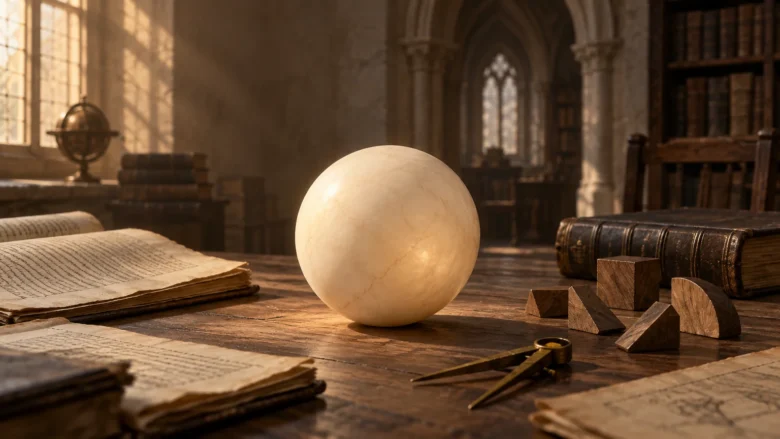
TLDR: Divine simplicity explained in one sentence: God is not assembled from parts, properties, ingredients, or conditions more fundamental than himself. In classical Christian theology, God does not merely possess goodness, life, wisdom, and power as separable qualities; God is the undivided reality from which all creaturely goodness, life, wisdom, and power derive. “Simple” therefore does not mean easy to understand, simplistic, impersonal, or composed of only one divine person.
The doctrine can sound remote, but its central concern is practical and theological. If God’s goodness were a feature added to God, could it be lost? If God depended on constituents that had to be combined, would something more basic explain God? Divine simplicity answers that God’s life and character are neither borrowed nor precarious. That answer has deep roots in classical theology, though its strongest formulations continue to generate serious debate.
Divine simplicity explained through a basic contrast
Ordinary things are composite. A house depends on materials and a builder. A living body has organs. A person’s existence is distinguishable from that person’s abilities, relationships, and moral qualities. Even an immaterial object might be called composite if its identity depends on distinct metaphysical principles.
Classical divine simplicity denies that God is composite in any of these ways. The doctrine is a major feature of classical theism, represented in influential forms by Augustine, Anselm, and Thomas Aquinas. Contemporary philosophers still dispute both its coherence and its consequences. The Stanford Encyclopedia of Philosophy overview of divine simplicity offers a detailed map of those historical and philosophical discussions.
| Composite creatures | God in classical divine simplicity |
|---|---|
| May have bodily or material parts | Is not a body assembled from material parts |
| Receive existence under particular conditions | Does not receive existence from another |
| Possess qualities that can develop or diminish | Does not acquire or lose goodness, wisdom, or power |
| Depend on constituents and their arrangement | Does not depend on more basic constituents |
| Have unrealized capacities | Is not understood as moving from potentiality to actuality |
This comparison states the classical position; it does not prove it. The argument depends on further judgments about dependence, causation, perfection, and what it means for God to be the ultimate source of reality.
What kinds of composition does the doctrine deny?
The word “parts” can be misleading because it suggests only physical pieces. Aquinas’s treatment in Summa Theologiae I, question 3, proceeds through several possible kinds of composition. He asks whether God is a body, whether God consists of matter and form, whether God’s essence differs from God’s existence, whether God has accidents, and finally whether God is composite in any way.
- Bodily parts: God is not a physical object whose continued existence depends on spatial pieces remaining together.
- Matter and form: God is not matter organized into a particular kind of being.
- Potency and act: God does not possess unrealized capacities that must be activated by another cause.
- Essence and existence: in Aquinas’s account, what God is cannot be separated from the fact that God is.
- Substance and accidents: wisdom, goodness, or power are not optional additions attached to an otherwise featureless divine substance.
These distinctions belong to a particular classical metaphysical vocabulary. Readers need not accept the entire framework to understand its purpose: Aquinas is progressively excluding every structure that would make God dependent upon constituents, development, or an explanation outside God.
Why did classical theologians affirm simplicity?
The central rationale concerns dependence. A composite thing appears to depend on its constituents and, in some sense, on their union. A house depends on materials arranged as a house; a living organism depends on functioning organs. If God were composite, classical theists argue, God would likewise require an explanation for the constituents and their unity. God would no longer be the ultimate source of being.
This reasoning connects simplicity to divine aseity, the claim that God exists from himself rather than receiving life from another. It also connects simplicity to necessity and immutability. What acquires a quality can potentially lose it, and what moves from one condition to another has capacities that were not previously actual. The simple God, by contrast, does not become good, wise, or alive.
The argument therefore intersects with broader questions about explanation and dependence. Readers interested in that philosophical background may also consult this overview of the principle of sufficient reason, while recognizing that divine simplicity does not follow automatically from every version of that principle.
What does “God is his attributes” mean?
The strongest classical formulation is sometimes summarized as “God is what God has.” A human being can possess wisdom without being wisdom itself. Human wisdom can increase, fail, or coexist with foolishness. On a strict account of divine simplicity, God’s wisdom is not one property placed alongside divine goodness, justice, and power. None of these is an independent component that combines with the others to make God.
Augustine describes God as both simple and unchangeable, arguing that substance and quality are not separate in God as they are in creatures. Aquinas develops the denial of composition through the metaphysical distinctions considered in his question on simplicity.
This does not mean that “wise,” “just,” “merciful,” and “powerful” are interchangeable words. They differ in meaning and describe genuine ways creatures know and encounter God. The more difficult claim is that their distinction in our concepts does not require separate components within God. Classical theologians commonly say that finite minds apprehend the one divine reality under multiple descriptions because no single creaturely concept comprehends God fully.
Consider justice and mercy. They can pull human agents in different directions because our knowledge, motives, resources, and actions are limited. The doctrine says that God is not divided between two competing internal faculties called Justice and Mercy. It does not remove the need to explain how divine judgment and forgiveness relate; it denies that their relationship should be pictured as a negotiation among parts of God.
Is simplicity compatible with the Trinity?
Divine simplicity does not mean that God is one person. Classical trinitarian theology distinguishes three persons—Father, Son, and Holy Spirit—without treating them as three pieces that together constitute God. Each person is confessed as fully divine, not as one-third of the divine substance.
The intended distinction is between personal relations and constituent parts. A part is less than the whole and helps compose it. The Father, Son, and Spirit are not portions of a larger deity. Simplicity is consequently meant to protect divine unity, while trinitarian doctrine identifies real personal distinctions that do not divide the divine being.
That answer is easier to state than to explain. Different theological traditions use different accounts of person, relation, essence, and divine action. It is therefore unhelpful either to claim that simplicity eliminates all trinitarian difficulty or to assume that every distinction must be a separation into parts.
Can a simple and unchanging God respond to prayer?
Scripture portrays God as judging, forgiving, grieving, relenting, showing compassion, and answering prayer. It also speaks of divine constancy. James 1:17 describes the Father of lights as one with whom there is no variation or shadow due to change. That verse can frame the biblical concern for God’s steadfastness, but it is not by itself a proof of the full metaphysical doctrine.
A common classical answer distinguishes change in creatures from change in God. A prayer may be part of the created history through which God eternally wills a particular outcome. The person, circumstances, and relationship undergo real change; God does not acquire new information or revise an improvised plan. Likewise, descriptions of divine grief or relenting may communicate a real change in God’s dealings with creatures without requiring an alteration in the divine character.
Critics reply that this account can make divine responsiveness seem too remote or redefine relationship until it no longer resembles meaningful personal interaction. Defenders answer that perfect constancy is not indifference: an unwavering love can produce different effects as its recipients and their circumstances change. The dispute concerns not whether biblical language matters, but what kind of reality that language attributes to God.
Does simplicity make creation necessary?
This is among the doctrine’s hardest problems. If God’s will is identical with God’s necessary being, critics ask how God can freely will a world that did not have to exist. Would a necessary divine act not produce a necessary creation? Related questions concern how an unchanging God knows contingent events and how genuinely different divine actions can arise from a simple cause. These remain central modern objections to strict divine simplicity.
Classical defenders generally distinguish the necessity of God’s willing from the necessity of the object willed. God necessarily wills the divine goodness, they argue, but does not need creation in order to be complete. God can will contingent creatures without those creatures becoming necessary in themselves. Critics question whether that distinction sufficiently protects alternative possibilities and divine freedom.
The issue should not be resolved by slogans. “God is simple” does not by itself explain why this world exists rather than another, just as “God is free” does not by itself explain how divine freedom relates to immutability. A satisfactory account must show how the doctrines fit together.
Must Christians accept the strongest version?
Christians who affirm divine simplicity do not always mean precisely the same thing. A strong Thomistic account denies every metaphysical composition in God and identifies God’s essence with God’s existence. Other theologians use simplicity more modestly to emphasize God’s unity, self-sufficiency, integrity, and the inseparability of the divine attributes without endorsing every claim of strict attribute identity.
Contemporary critics may accept that God has no body and depends on nothing external while rejecting the conclusion that every divine attribute is identical with every other. They argue that meaningful distinctions among knowledge, power, goodness, and will need not turn God into a collection of parts. Defenders respond that merely grouping inseparable properties together may leave unexplained why those properties are necessarily united and why God possesses them without dependence.
Differences between Western, Eastern Orthodox, Reformed, and contemporary analytic approaches also require tradition-specific attention. Shared vocabulary can conceal different accounts of essence, energies, attributes, relations, and divine action. It is safer to examine what a theologian actually affirms than to assume that the label “simplicity” identifies one uncontested formula.
How to evaluate the doctrine
A beginner can keep four questions in view:
- What kind of composition is being denied—physical parts, metaphysical principles, distinct properties, or all of these?
- What theological concern is the denial protecting—divine unity, aseity, perfection, immutability, or something else?
- How does the proposed account preserve meaningful language about wisdom, love, justice, freedom, and personal relations?
- Can it explain creation and biblical descriptions of divine response without making God dependent or making creaturely history unreal?
These questions prevent two opposite mistakes. One is dismissing simplicity as though it merely said that God is uncomplicated. The other is treating every strong philosophical conclusion as if it were explicitly stated in a single biblical verse. Divine simplicity is better understood as a theological synthesis: an effort to reason from claims about God’s unity, independence, perfection, and constancy toward an account of what God must be like.
The practical takeaway
At its best, divine simplicity says that God’s goodness is not borrowed, God’s love is not a mood, and God’s life is not sustained by conditions beyond God. The doctrine asks Christians to stop imagining God as a larger version of a creature—a being assembled from admirable traits—and to consider God as the undivided source of all creaturely existence and goodness.
Its strongest formulations also carry genuine intellectual costs. Questions about freedom, contingency, the Trinity, prayer, and the distinction among divine attributes cannot be waved away. Readers should approach the doctrine neither as an obvious proof nor as meaningless abstraction, but as a demanding proposal about divine independence.
A useful next step is to read Aquinas’s Summa Theologiae I.3 alongside biblical passages about divine oneness, faithfulness, non-dependence, and constancy. Ask in each case what the text or argument directly establishes and what further metaphysical conclusions a theologian draws. That distinction makes it possible to understand divine simplicity before deciding which formulation, if any, is persuasive.